Lent is here, and if you have not already begun a Lenten Discipline, you might feel a little anxious. The countdown to Easter has begun - what can be done to make the best use of this time of preparation? Especially if you feel you are already behind in this effort!
Lent does not have to completely alter your normal schedule to be powerful and help you to feel changed in a really beneficial way. Here are five things you can add to your life that will only take a few minutes, but may just alter your perspective. (And you do not need to add all five things - pick what works for you!)
1. Do one nice thing each day. This could mean offering a smile to someone you pass on the street, letting a car into traffic ahead of you, or paying for the coffee of the person behind you at the drive through. Savor a small moment of pleasure in offering this tiny gift.
(This is good for your heart.)
2. Make note of two things you are grateful for each day. As you wake up in the morning, even before you get out of bed, think of a gratitude. Repeat the process as you lay your head down on your pillow at night. Starting and ending each day on a positive note is bound to improve your outlook.
(This is good for your soul.)
3. Read three pages of a book. Okay - you might read a lot every day, but for some of us, making our way through that book might be taking far too long as we are dragged away to other things. Make that time to read just three pages of whatever you want (this does not have to be a Lenten devotional!) and enjoy making progress.
(This is good for your mind.)
4. Drink four glasses of water each day. Again, some of you are far ahead on this - others need a little reminder to stop, get up and move around, re-hydrate, stretch a little, and maybe take a moment to be grateful for being alive today. (This is good for your body.)
5. Take five minutes to talk to God - no interruptions allowed. Walk away from the phone or computer (or the family) and just be quiet with God. You might write out a note, or pray silently, or doodle as you think, or just stare into space. Use this time for you and God to be together. This is time well invested in your most important relationship.
(This is good for your spirit.)
The days we count as we approach Easter will go by very quickly. You owe it to yourself to make the most of them. It doesn't require a special book, or a retreat - just you and God. You have the time and the tools already, and these Lenten practices might even last beyond the forty days.
Monday, February 15, 2016
Tuesday, January 26, 2016
"WHAT IN YOUR FAITH INSPIRES PEACE AND HOPE?" A Christian perspective
shared by Rev. Charles Edward, OLW, Deacon
"WHAT IN YOUR FAITH INSPIRES PEACE AND HOPE?"
This is a very loaded question. Just as we are all connected
by our humanity and our one breath, so too are we all connected. All humanity longs for something. Be it
affirmation, acceptance, love and a
desire to be made whole.
The vehicle that
inspires me the most on this journey is that of prayer and
community. To some it may sound a little
bit odd that I am not focusing of Jesus.
But the true essence of Christianity
is to be in relationship with the Infinite / God. Pure Love.
To me that is revealed in the gift of His Son. Fully human and full divine. In the humanity of Jesus, we see that he is
always longing for a relationship with His Father. Relationship is being in conversation with
one and other which less to community.
That is what prayer is. The examples of those individuals in
Scripture hold for my a sign for a deeper relationship with the Infinite.
This longing is not self contained. It is contagious. It moves me to a wide way of living out my
humanity. The is why community is so
important.
Jesus NEVER JUDGED ANYONE.
He is the perfect reflection of PURE LOVE which we all long for. That realty gives me a Peace that this
culture cannot give me.
We all live life in the ordinary. The very fact that we are here shows that we
are all on a journey but have various
paths. One is not above the other. Just a different observation leading to
living "life to the fullest".
Nothing more nothing less.
That is the core of
the teaching of Jesus. "Love the
Lord your God and your neighbor as
yourself." Culture tells us that we are our own person. But in reality we
are communal people.
Community to me is where my hope lies. It is here that hope is created. Being able to see the diversity in each of
us. Thank God that he did not have a
cookies cutter. Our lives would be very
boring. But the key question that I
pose is this " Are we willing to be
really be open to that reality?"
It's taking a risk of either being accepted or rejected.
So are you and I willing to take that risk? I say "YES" that's the reason for
our being here.
{On Jan 24th, Brother Charles Edward was a participant in an Interfaith Forum, held at St. Paul's
Church (see picture above). These are some of his thoughts around the topic "What in your faith
inspires peace and hope?", told from a Christian perspective}
Sunday, January 17, 2016
It's What's Inside That Counts (or do you put leaven in your bread?)
The lesson shared in the Sunday school classrooms this morning will be the Parable of the Leaven. In reflecting on many different news stories and media campaigns this week, it seemed the Holy Spirit was choosing for me as I prepared for the presentation to the class this morning, as well as thought about Martin Luther King Day (or in some places Civil Rights Day) tomorrow.
In the parable, the woman mixes leaven into the flour, and the bread rises. Simple really, yet there is so much "bubbling" under the surface.
In the current political race, we are told repeatedly, by all sides, that we need to look carefully and see the true nature of the candidates, with every individual convinced they are the best one for the job. We need to look at what is inside.
This past week, the Anglican Communion suspended the Episcopal Church from full privileges and voting rights due to the work of the Episcopal Church to allow same sex unions in church, as well as other decisions. What is inside all of this? Are we to continue to love all and accept all as Jesus taught (the opinion of the Episcopal leadership) or love all people, but become more reserved in our open acceptance (as statements from the Anglican leadership suggest). With the record the Episcopal Church has on many civil rights issues, it seems very unlikely that any steps will go back. This leads to many questions, including what is inside each of us? If we say that we are to love one another, how do we respond to this new situation?
Tomorrow, we will recognize Civil Rights Day. We will think about and honor so many who have tried to make us focus on something that is really simple - it is what is inside that counts. Not the color of our skin, where we live, how much money we make, what political party we may call our own, or what church we worship in - but what is inside each of us.
So, whether you will mix three measure of flour with leaven or not, you have a chance today to wonder about how God works inside you. I wonder, what will you find? I suspect you will like some parts of yourself more than others - as that is the nature of humans. But if you remember the teachings we share in our church, you will know that God loves and accepts you for you, and asks us to do the same for others. That can be very difficult when we disagree, but hopefully remembering this will allow us to share in peaceful disagreements, and set an example of demonstrating kindness, even to those who do not ask for it, in all areas of our lives.
It is indeed what is inside that makes all of the difference.
In the parable, the woman mixes leaven into the flour, and the bread rises. Simple really, yet there is so much "bubbling" under the surface.
In the current political race, we are told repeatedly, by all sides, that we need to look carefully and see the true nature of the candidates, with every individual convinced they are the best one for the job. We need to look at what is inside.
This past week, the Anglican Communion suspended the Episcopal Church from full privileges and voting rights due to the work of the Episcopal Church to allow same sex unions in church, as well as other decisions. What is inside all of this? Are we to continue to love all and accept all as Jesus taught (the opinion of the Episcopal leadership) or love all people, but become more reserved in our open acceptance (as statements from the Anglican leadership suggest). With the record the Episcopal Church has on many civil rights issues, it seems very unlikely that any steps will go back. This leads to many questions, including what is inside each of us? If we say that we are to love one another, how do we respond to this new situation?
Tomorrow, we will recognize Civil Rights Day. We will think about and honor so many who have tried to make us focus on something that is really simple - it is what is inside that counts. Not the color of our skin, where we live, how much money we make, what political party we may call our own, or what church we worship in - but what is inside each of us.
So, whether you will mix three measure of flour with leaven or not, you have a chance today to wonder about how God works inside you. I wonder, what will you find? I suspect you will like some parts of yourself more than others - as that is the nature of humans. But if you remember the teachings we share in our church, you will know that God loves and accepts you for you, and asks us to do the same for others. That can be very difficult when we disagree, but hopefully remembering this will allow us to share in peaceful disagreements, and set an example of demonstrating kindness, even to those who do not ask for it, in all areas of our lives.
It is indeed what is inside that makes all of the difference.
Image of yeast bubbling over
Saturday, October 17, 2015
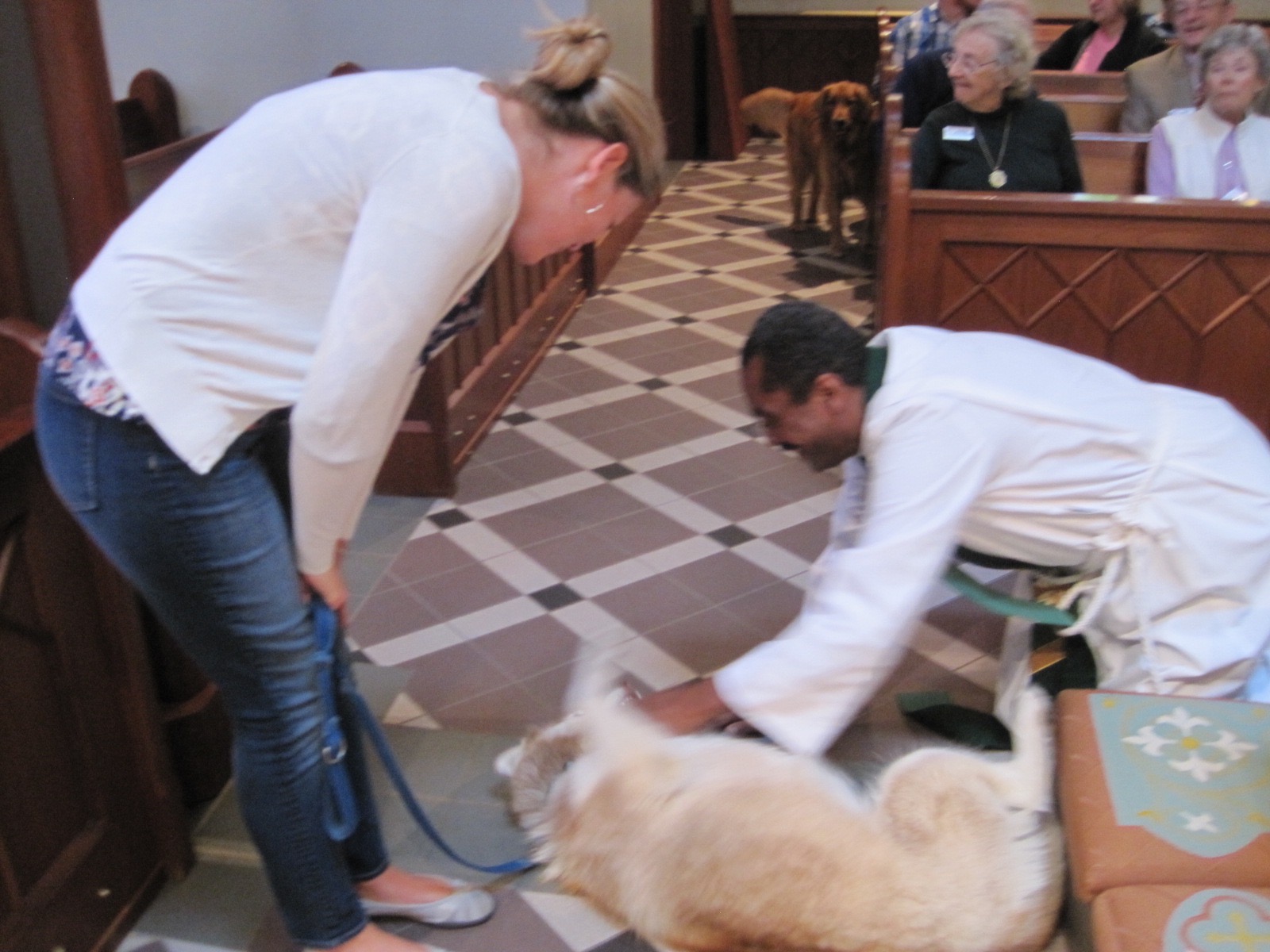
Pictures from our wonderful Animal Blessings on St. Francis Day!
We received so many wonderful pictures of the Animal Blessings, indoors and outside! Here are just some of our favorites. Thanks so much to all who participated, and to our God for making all of the wondrous variety of creation!
Holy God:
No sparrow falls without your attention; nothing dies that is lost to you;
nothing comes into being without your love.
Give us just and compassionate hearts, that we may serve the earth and all its creatures,
holding fast to the vision of your peaceable reign in which all will live with you
eternally; through the Risen One, Christ our Savior.
Amen.
Wednesday, September 30, 2015
Shabby Scriptures
The word of our God shall stand for ever.—Isaiah 40:8
The Sunday, November 20, 2005 entry by Gail Thorell Schilling included in the “Daily Guideposts 2005” is reproduced with permission from Guideposts, Guideposts.org. Copyright © 2004 Guideposts. All rights reserved.
My Bible is falling apart. And no wonder; I received it at Sunday
school on September 29, 1957.
With colorful plates, maps, a concordance
and student dictionary complete with illustrations from ark through Zion, it
was perfect for a child.
Of course, I’m no longer a kid. Over the
years the inexpensive leatherette cover has broken off along the edges. The
gold leaf gilding on the title rubbed off years ago and “Holy Bible” has become
a dull gray shadow. In fact, the entire front cover sloughed off a couple of
months ago, taking the first forty nine chapters of Genesis with it. I stuck it
back with cellophane tape, but even that has loosened, so I keep my Bible
together with a rubber band. My shabby Scriptures.
They should look a lot worse. For the
first thirty years I owned this Bible, I thumbed through it only casually,
mostly at Sunday school. Then a dear friend introduced me to daily devotional reading—just
as I was going through a divorce with four small children to care for. Bible
reading became part of my early morning routine. Over the next fifteen years I
underlined and highlighted my favorite passages, all the verses that really
made a difference to me. Now I wouldn’t trade that Bible for a more handsome or
sturdier edition. It’s my constant companion, my never failing guide through
life. No matter what struggles I’m going through, I can always turn to it for
the help
I need.
Yes, my Bible may be falling apart, but
thanks to the wisdom in its pages, I’m not!
Dear Lord, thank You for Your Word hidden
in my heart.
—Gail Thorell Schilling
The Sunday, November 20, 2005 entry by Gail Thorell Schilling included in the “Daily Guideposts 2005” is reproduced with permission from Guideposts, Guideposts.org. Copyright © 2004 Guideposts. All rights reserved.
Wednesday, September 23, 2015
Help Me to Trust Your Time...
A time to plant, and a time to pluck up that which is planted.—Ecclesiastes 3:2
The Thursday, August 26, 2004 entry by Gail Thorell Schilling included in the “Daily Guideposts 2004” is reproduced with permission from Guideposts, Guideposts.org. Copyright © 2003 Guideposts. All rights reserved.
Blue flax, newly transplanted from a friend’s yard, fluttered by
the mailbox as I stared dumbly at the letter from my landlord of five years.
“Therefore, you must find another rental before September 1.”
I shook my head in disbelief. Just a few
months earlier the same landlord had invited me to choose new carpet and plant
a garden. All spring I had removed sod, forked loam, fertilized and planted
gifts from my friends’ gardens. Now the delphinium, lavender, lilies, tulips, daffodils
and veronica would stay behind. I’d be gone before the painted daisies, grown
from seed, showed their colors.
Leaving my garden was the least of my
worries. Where would I go? Rentals were few, and my job search hadn’t turned out
the way I had hoped. After twenty three years in my cozy community, why was
everything falling apart now?
Or was it? For several years I had pondered relocating two
thousand miles back east to my native New Hampshire to keep closer tabs on my
frail parents, who were now in their eighties. Was this the right time?
Within days, pieces of the
transcontinental move clicked together: I would live at my parents’ summer
place in New Hampshire, just an hour away from them, and teach at a nearby
junior college. Carol, my friend since college, would drive back with me. I
would keenly miss my community and my garden, but I knew my parents needed me
nearby.
Minutes before departing, I dug up the
English rose I’d planted just weeks earlier. “Rosie” would travel with us and
begin a new life in New Hampshire, too. As I started the car to begin our
journey, Carol slid in and offered me a nosegay plucked from my now abandoned garden.
She smiled.
“Something pretty for the trip—and seeds for your new garden.”
Lord of creation, help me trust Your time,
not my own.
—Gail Thorell Schilling
Wednesday, September 16, 2015
Grace - and Pie
But unto every one of us is given grace.… —Ephesians 4:7
The Monday, February 11, 2013 entry by Gail Thorell Schilling included in the “Daily Guideposts 2013” is reproduced with permission from Guideposts, Guideposts.org. Copyright © 2012 Guideposts. All rights reserved.
“I'm just stupid!” wailed my daughter Tess, then twelve, as she
slammed her bedroom door. She had tried to make macaroni and cheese out of a
box; unfortunately, she hadn't drained the water before adding the cheese
powder. Now her siblings teased her about her “orange soup.”
“Dear Lord, this child needs a success,
quick! What can I do?”
Try again. Cook something easy with her.
Don't give up or she will too.
When I invited Tess to make dessert, she
zeroed in on a new recipe, Pink Angel Pie: prefab pie crust, a can of cherry
filling and some meringue. How hard could that be?
First, she jerked the plastic wrap off the
frozen shell, sending it skidding across the counter to shatter on the floor.
Before she could cry, I picked up the pieces and swallowed my rebuke. “You know,
Tess, pie dough is just like clay. You can just pinch it and press it back
together.” Next, she opened the can of cherry filling and dropped the gooey lid
on the kitchen rug. I stayed calm.
Now the tricky part: separating eggs. Once
again, I withheld critique as she fished a few egg shell shards from the bowl,
then beat the egg whites soft and high, splattering meringue on the cabinets.
With a flourish, my increasingly confident daughter spread the fluffy topping
on her creation and slid it into the oven for browning.
Well, Tess's dessert drew rave reviews
from her siblings, and “orange soup” has become a family legend. Best of all,
God gave both my daughter and me grace when we sorely needed it, thanks to Pink
Angel Pie.
Gracious Lord, thank You for sending abundant grace wherever we
are, even in a stained, meringue spattered kitchen.
Digging Deeper: Ps. 21:6–7; Luke 6:37–39
The Monday, February 11, 2013 entry by Gail Thorell Schilling included in the “Daily Guideposts 2013” is reproduced with permission from Guideposts, Guideposts.org. Copyright © 2012 Guideposts. All rights reserved.
Monday, July 27, 2015
Abundant Life
by the Rev. Kate Atkinson
We talk a lot about the abundant life that Jesus offers
us. It crops up in sermons, in prayers,
and in conversations. But what exactly is it? And why is it so important?
The interesting thing about abundant life is its quality of simplicity. That may seem like a contradiction in terms:
the word “abundance” suggests a large quantity of something; a generous supply
of whatever we think will bring us pleasure.
And, frankly, many of us spend a lot of time seeking out those things. We strive to accumulate money, clothes, to
enjoy good food and drink, to acquire material possessions of all kinds, along
with other evidence of our wealth and success.
But the power of abundant life comes from the absence of
trappings. Abundant life is found in
uncluttered, unpopulated, uncomplicated moments occurring in the midst of a
hectic lifestyle that’s familiar to us all.
In order to receive the full benefit of abundant life, we
have to make space for it. In the jam-packed, technology-driven culture of
western civilization this may be an alien concept but it’s essential – and it’s
biblical too!
We’ve always known that our bodies are designed with a
requirement for rest and refueling – and as civilization has advanced, we’ve
recognized a need that goes beyond the basics of food and sleep. That’s why vacations were invented!
But Jesus invites us into something more than a
vacation. He urges us to follow his
example; he invites us to spend time in God’s presence, to be restored and
renewed by the power of the Holy Spirit.
Jesus understands that our bodies and our spirits need rest and
sustenance.
How will we respond to that invitation? It may be a little easier at this time of
year, when God’s Creation beckons to us in so many ways. We might take a
solitary walk on the beach, or hike up a mountain with friends. We might wander through the woods or skim
across a lake. Or we might relax in our
own back yard, listening to peaceful music, or birdsong, or the wind in the
trees.
There are as many ways of finding rest and restoration as
there are people in need of those things – and we know when we’ve discovered
our unique way because we experience a divine abundance unlike anything the
world can offer. We may not even be able to express it but the effects are
unmistakable. We’re re-energized from
deep within our soul – overflowing with the peace that passes understanding.
Unlike so much that we hear about today, abundant life is
not “all about me” – it’s all about God.
It’s all about moving away from the distractions that crowd our daily
life. And it’s about recognizing our
need for God’s restorative love – love that can be expressed in any number of
ways but is always intended to inspire and delight and energize us.
Abundant life is waiting for us all the time – on the outer
edges of our vision, on the fringes of our awareness. All we have to do is step
toward it, take a breath, and receive.
Friday, July 10, 2015
3 Practices that can Change our Life and Transform our Church!
by the Rev. Kate Atkinson
Over
the past three years, the Taskforce for Reimagining the Episcopal Church (TREC)
has been hard at work examining our church structure, governance, and
activities at global and local levels – and everywhere in between. One result of their efforts was the
development of three practices, rooted in the gospels, which inspired a theme
for the 78th General Convention of The Episcopal Church. It showed up in the opening remarks from our
current Presiding Bishop, Katharine Jefferts Schori, and our House of Deputies
President Gay Jennings. It flowed through the speeches from the nominees for
Presiding Bishop; it appeared in the sermons at our daily Eucharist; and it
featured in the materials on display, and our daily prayers and songs and
conversations:
Follow Jesus
into the neighborhood
… travel lightly.
There
was a powerful sense of the Holy Spirit in Salt Lake City, inspiring us to
recommit to what Bishop Curry calls “the Jesus movement … the movement of God’s
love in this world.” There was a clear and genuine response to that call to
follow Jesus wherever he may lead us next.
And
where is Jesus leading us? The stories
we heard at General Convention, the resolutions we passed, the new directions
we agreed upon, these all helped us to understand that what we call “the
neighborhood” may not always be familiar surroundings. As Jesus reminds us in
the parable of the Good Samaritan, a neighborhood is any place that offers us
the opportunity to make new connections, to build new relationships, to
discover who our neighbors really are.
And,
as Jesus instructed his disciples, when we begin to explore those new
neighborhoods, it’s important to leave our luggage behind. Traveling lightly means letting go of old
ways of doing things, old prejudices and pre-conceived ideas of ministry and
mission. Traveling lightly means being
open to learning from the people we encounter, hearing their stories, allowing
them to tell us what they are looking for; not the other way around.
We
have an adventure in store for us – this church that could sit back and boast
about all we’ve achieved but chooses instead to keep moving forward.
As
Bishop Katharine said when she preached on the story of Jairus’ daughter, it’s
time to get up:
“Get up girl, and boy, and woman and man,” she
told us, “get up and dance!”
Find
out more about the 3 Practices at:
Sunday, July 5, 2015
Our New Presiding Bishop!
There was much buzz at the church this week about our new Presiding Bishop-Elect, the Rt. Rev. Michael Curry. A charismatic man, a deeply grounded man, and one who can reach out to you as he speaks - his election as Presiding Bishop is historic as he is the first black Presiding Bishop in the Episcopal Church. Known for his book "Crazy Christians: A Call to Follow Jesus" *, as well as his dynamic speaking ability, we thought you would enjoy the opportunity to have him introduced to you through these video links.
Enjoy!
This is Bishop Curry's sermon from the closing Eucharist of the Episcopal Youth Event in Philadephia, PA July 2014.
https://www.youtube.com/watch?v=TTDRnr0fGBQ
This is a video from the website, scholarpiests.org, with Bishop Curry speaking about the Eucharist.
https://www.youtube.com/watch?v=USOMZpGheBc
And this is the sermon Presiding Bishop-elect Curry preached at General Convention.
https://www.youtube.com/watch?v=vj_N3OsHxxo
May we all hold Bishop Curry and all other Bishops, Priests and Deacons in the church in our prayers as they move forward doing the work of God, following in Jesus footsteps!
**"Crazy Christians" is available through Amazon.com, and if you have an Amazon account and use their "smile" program to allow a percentage of purchase costs to be donated to a charity, you may now designate St. Paul's Episcopal Church in Concord as your charity of choice!
Tuesday, June 30, 2015
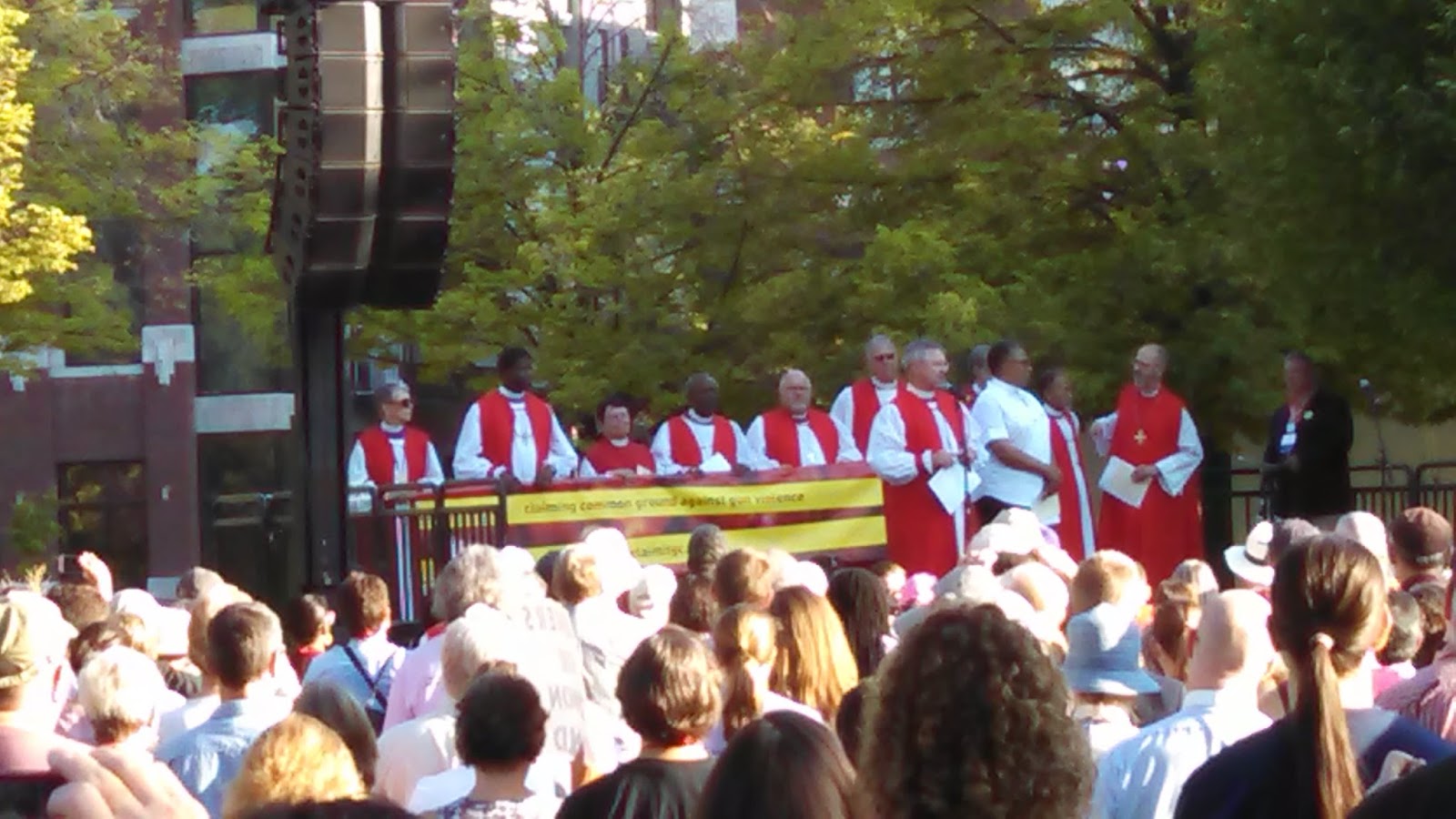
March Against Gun Violence - Episcopal General Convention 2015
Sunday Morning, Day Four of General Convention
As
the 10:00 congregation gathered for worship at St. Paul’s in Concord, here in
Salt Lake City I was in the midst of a huge crowd, marching through the streets
and singing together: “Out of the depths I call unto thee, O Lord; consider
well the longing of my soul.”
We
were led by nearly a hundred of our bishops, dressed in their full vestments
(minus mitres!), and we were united in our determination to bring an end to gun
violence. Each member of the New
Hampshire deputation wore a T-shirt bearing the image of Seminarian Jonathan
Daniels (shot and killed 50 years ago while protecting a young black girl) and
the words, “We are indelibly, unspeakably one.”
Our
speakers included Carolyn, the mother of young girl who was killed before her
eyes, in a Utah shopping mall, by a shooter who claimed eight other victims
before he himself was shot and killed.
The mother, shot at point blank range, still carries dozens of shotgun
pellets in her body, leaching lead and causing her chronic, devastating pain
and nausea. But that is nothing compared
to the agony of losing her youngest child.
She has become a crusader for gun control.
Our
speakers reminded us over and over that this is not about denying the right to
own firearms; it is about ensuring that dangerous weapons do not get into the
hands of those who are not safe to own them.
Background checks will ensure that people who are mentally ill, or who have
criminal records or histories of domestic abuse, will not be able to purchase
guns. And lives will be saved. As Carolyn said to us, we don’t know who will
be saved because they will still be alive; they will still be here with
us. We can’t picture the faces of the
people who will not die from gun violence because of improved controls – but
some of those faces may be right in front of our eyes right here, right now.
As
our hearts continued to ache for some of the latest victims, our brothers and
sisters at Emanuel Church in Charleston SC; as we marched, and sang, and prayed
through the early morning heat of Salt Lake City, this assembly of
Episcopalians recommitted ourselves to breaking the unholy trinity of poverty,
racism, and violence, and to draw strength and inspiration from our holy
Trinity of Creator, Redeemer and Sanctifier, and to step up our efforts to
bring an end to gun violence.
When
our march came to an end, our Presiding Bishop-Elect, the Rt. Rev. Michael
Curry sent us off with the closing words: “ALL lives matter because we are ALL
God’s children.”
Read more about the experiences of the NH Deputation in Salt Lake on their own blog:
Monday, June 22, 2015
Planting and Nurturing the Kingdom of God
from a sermon by the Rev. Kate Atkinson June 13/14 - Read the full sermon here.
Jesus tells us that
the kingdom of God is like a seed scattered on the ground that sprouts and
grows overnight while the person who planted it is asleep. And the kingdom of
God is like a mustard seed that grows into a shrub as big as a tree, so large
that birds can nest in the shade of its branches. (Mark 4:216-34)
In this season of
gardens and fresh produce, we can appreciate Jesus’ imagery. We understand how satisfying it is when the
seeds we plant take root, thrive and grow, and especially when they produce the
flowers or vegetables or fruit that we’re hoping for. And when we apply that understanding to the
idea of the kingdom of God – we begin to see how we can affect the growth and vitality of that kingdom.
Bishop Rob and his
colleagues at Diocesan House define “Congregational and Mission Vitality” like
this:
“A vital
congregation is a place of joy, exploration, experimentation, and discovery of
what God is doing in the world. A vital
congregation is a place where apostolic ministry germinates and thrives; that
is, where our people are formed as
disciples and then are sent out
to join God’s mission of healing, joy and hope-bearing, peace-making, and
justice proclaiming.” (Diocese of NH 2016 Budget Narrative)
Once again we hear
the language of agriculture, of growing into what God calls us to be – and
discovering how fulfilling that process can be.
Our
service to others is not distant or removed. We make connections with the
people we serve; we learn their names and respect their dignity. And just as
the birds of the air can make their nests in the shade of a tree that grew from
a tiny mustard seed, people who come to St. Paul’s for support find a place of
welcome, encouragement, and relief. The
kingdom of God begins with simple things – like soil and seed, or food and
friendship – and it never ends with just one person. It is always growing, always expanding,
always welcoming more and more people into its boundless embrace.
As
this summer season begins, with all the new growth, all the reminders of God’s
abundance that surround us, what new seed of faith can we nurture in our
individual lives? And how much will it
have grown by summer’s end? How far will
its branches extend? How many other
lives will it touch and change?
Wednesday, June 17, 2015
Outdoor Service and Parish Picnic 2015
We had an absolutely beautiful day for our annual outdoor service and picnic in the park! If you missed out, or just want to relive the fun, here are some pictures shared by a parishioner. Enjoy!
Saturday, June 13, 2015
The Journey
from a sermon by the Rev. Kate Atkinson, June 7, 2015
To read the full sermon, please visit our website
Early in the morning of June
6, Alan Barlow, a member of St. Paul’s, embarked on what he calls Alan’s
Journey. He left Heceta Beach, Oregon,
with a stroller packed with survival equipment, and began running across the
United States – a total of 3,200 miles to his destination of Rye Beach here in
New Hampshire. Every step he takes over
the next five months or so is for the benefit of St. Paul’s food pantry – and
you can follow Alan’s progress, and add your support, through St. Paul’s website.
The idea of a cross-country
run came to Alan literally out of the blue one day – and he has been planning and
training for the past eight years. As
soon as his family and friends realized he was serious, they started trying to
talk him out of it – but Alan is certain that he is doing what he is called to
do. He is certain that God is at the
root of this amazing journey, and there is no way he can choose not to do it –
not even when the people he loves more than anything might beg him to
reconsider.
God gives us the power to do
greater things than we may ever have thought possible – even when those things
may go against the wishes of people we love and respect. These are hard choices to make but we know
beyond doubt when we have chosen the right way.
And when God calls us to journey new and unexplored paths, we can be
sure of God’s strength and peace and continued presence as we obey that call.
O God, from whom all good proceeds:
Grant that by your inspiration we may think those
things that are right,
and by your merciful guiding may do them…
(Collect for the Second
Sunday after Pentecost: Proper 5)
Alan with his supply stroller
Tuesday, May 26, 2015
Listening
Shared by Jerry Tepe
It is said that Sigmund Freud coined the phrase “How long
have you been hearing these voices?” I don’t know if that is true, but you
often hear that phrase when, jokingly, questioning a friend’s sanity.
But can you imagine what it was like on the Day of Pentecost
when each heard the voice of the Holy Spirit speaking to them in their own
language; in a voice they alone could understand? You experienced a bit of
what that might have been like if you attended the 10:00 AM service this past Sunday when we read the Gospel in many
different languages. Amidst the cacophony of sounds, if you tried, you could pick
out the different voices. Most of us listened for the English, but if you understand a different language, say French, you may have been listening for that. It is amazing what the brain is capable of discerning.
In much the same way the Holy Spirit speaks to each and
every one of us in a voice we alone can understand – if we are willing to
listen. Amidst the cacophony of everyday life, be alert for that voice. If you
are alert, you will be able to discern the voice of the Holy Spirit calling to
you. All you need to do is be willing to listen – and then to prayerfully
follow.
So the next time a friend joking asks you “How long have you
been hearing these voices?” you will be able to truthfully answer “As long as I
have been listening.”
Friday, May 15, 2015
EfM is more than a bible study...
Have you heard about the “EfM” program and wondered what it
was? Did you hear the name “Education
for Ministry” and assume that the end goal of the program was an ordained
position such as a priest or deacon?
While the best way to learn about the program, and the impact it has on
the individuals who participate in it, is to have a conversation with an EfM
student or graduate, the following provides a bit more information.
The EfM program is described in this way on their website:
“Every baptized person is called to ministry. The Education
for Ministry (EfM) program provides people with the education to carry out that
ministry. During the Service of Confirmation we ask God to "Renew in these
your servants the covenant you made with them at Baptism. Send them forth in
the power of the Spirit to perform the service you set before them." EfM
offers an opportunity to discover how to respond to the call to Christian
service.”
EfM is a four-year course of study. The first year is dedicated to reading the
Old Testament, the second to the New Testament, the third year covers the
history of Christianity, and the fourth theology. What sets EfM apart from any other book
discussion group or class is the “one-room schoolhouse” atmosphere (all four
years are usually represented in a group) and conversations between
participants. The group members share
with one another and support one another in this journey of discovery. Each group has at least one mentor who is
there to facilitate the group discussion and lead the students in “theological
reflections” – opportunities to look at real life situations through the eyes
of people of faith.
We are all “ministers” in the church. Look at the bulletin at church this weekend,
and you will see above the service participants, “Ministers in Christ: The
People of St. Paul’s”. Those who become
involved with EfM do so to deepen their understanding of scripture,
Christianity, and their own personal faith.
We asked current and former participants in EfM to share
their thoughts on why they believe in Education for Ministry:
“EfM is more than a Bible study. You learn to think of theology and our
Christian tradition in a whole new way.
Through our discussions, I have come to discover things I never would
have found on my own. “- Mike Andres (current student)
“My first year experience in EfM has been a sharp learning
curve in understanding the history of religious beliefs and small group
analyses of how this history informs today's church. I value the
conversations we have in many forms: from structured TRs (theological
reflections), to discussing each year's readings and how they relate to one
another; and each members' opinions of how our beliefs play out in today's
world. “-Mary Farrell (current student)
“It is so hard to narrow it down to a few words as it was
such a great 4yrs and it went by so fast. One of the things that was so
enlightening and s great learning experience was the reading of the Bible and
the discussion that took place with all of us having a different interpretation
of what we read. This is just a small
part of what you take away from EFM.” - Fran Clapp (graduate 2014)
“I learned so much exploring the bible, Christian history, tradition, and interpretations of the Christian message. I will always treasure the close bonds formed with the members of my EfM group as we shared our personal stories and learned techniques for living our faith. “
--Connie Mitchell,
2010-2014
“The layers of impact from participating in EfM for four
years have been numerous. It has fulfilled me
spiritually, academically, socially and emotionally.
I have learned so much from scripture to history. Studying
theology in this last year has been both stimulating and eye-opening.
Group members have been so individual and engaged in how each presented and
shared each week: it was always a wonderful surprise to be part of what emerged
in our discussions. “ - Karen Schwinger
(graduating June 2015)
What might EfM mean to you?
In the UK the program is billed as “Exploring Faith Matters”. If you feel called to explore your faith
through the EfM program, please attend one of their upcoming information
sessions here at St. Paul’s. They will
be held on Tueday, May 26th at 7:00 PM, and Sunday June 7th at 9:00 and 11:30
AM. We will celebrate this year’s EfM
graduates at the 10:00 AM service on June 7th.
Tuesday, May 5, 2015
Moving Toward a Program Model Church - a Spiritual Reflection on Working in a Small Group Toward a Large Goal
Joanne H. Gutt, Vestry
Working toward a large goal is a daunting task. In order to
accomplish a
large goal it needs to be broken down into small pieces. There
is no room
for procrastination and at the same time it can’t be rushed.
Andrew
Hardister, Harriet Degreenia, Beth Nagy and I have been working
with Kate,
Keith and other Vestry members on St. Paul’s plan to move to a
Program
Church Mode. Hopefully you heard about it during the services on April 25 and 26 -
and you may read the report here.
As a small group we are learning to work together, listen to
each other
and worry together. We recognize that each of us has different
ideas and
talents and that we all have a limited amount of time. The
spiritual
aspects of working together include newly found friendships, the
bond
we feel for the project and the recognition that many hands make
light
work. As we recognize that this is hard work, we pray for
strength.
As we move forward in this project we pray for wisdom,
creativity and open
minds. We pray that as others join us in this journey, they will
also feel
the joy of accomplishment in doing the work Jesus wants us to
do.
“Don’t ask yourself what the world needs. Ask yourself what
makes you come
alive and then go do that. Because what the world needs is
people who have
come alive.” * Dr. Howard Thurman *
May we not do work because we think we ought to. Rather, may we
"come
alive" and see where that leads us.
Using information from our recently conducted church survey, the Vestry began their work of moving St. Paul's to a Program Model Church at their Vestry retreat in March. The presentation Joanne refers to in this blog post may be found here, along with more information about the Mutual Ministry Review process.
The photograph of the Vestry was taken at their retreat, where this important work was begun. (Several Vestry members were not present for the photo)
Monday, April 20, 2015
Fellowship
by The Rev. Kate Atkinson
We talk about fellowship a
lot at St. Paul’s – often including it in a list of three “F”s that describe a
social event: Fun, Food and Fellowship. But Christian fellowship means much
more than enjoying one another’s company at coffee hour, or a foyer group, or
even our monthly “Fellowship Potluck.”
In his commentary on the
Letters of John, the theologian, John Stott, describes what he calls “the
divine order” – angelia (message), koinōnia (fellowship), and chara (joy) – highlighting the middle
stage of that progression as vital to our Christian life.
(John R.W. Stott, The Letters of
John, Pg. 71 © 1996 Inter-Varsity Press, Leicester, England)
The apostle John wrote to the first century believers about the
importance of living in fellowship with God and with one another, specifically
so that we can live without sin, and ultimately so that “our joy may be
complete.” (1 John 1:4; 2:1)
In order to do that, John
writes, we have to take to heart the message that “God is light and in him
there is no darkness at all.” (1 John 1:5) Light
represents God’s glory and splendor – the divine radiance we imagine permeating
all of heaven. Light also represents purity and truth – divine qualities manifested
in Jesus. And God’s light is offered to us, the children of God, as a source of
power, salvation, and discernment.
Fellowship is the act of gathering
with other Christians and sharing our common awareness of God’s light. It
doesn’t necessarily require us to have deep, theological discussions every time we get
together (although sometimes that does happen), but it does mean striving for purity
and truth in what we say to one another and in our actions. It also means acknowledging that we are stronger,
safer, and wiser because of God’s presence with us.
That could mean talking about
the times we’ve fallen short of what we know God expects of us; it could
include occasions when we’ve struggled with Jesus’ teachings and ended up
disregarding them; it could be the times we’ve given into temptation of various
kinds. Being in fellowship with one another means recognizing that we all face
similar challenges – and we all need God’s help, and one another’s, to respond
to them.
Fellowship allows us to be
utterly transparent about who we are and who we’re striving to be as children
of a loving God.
To read more, please check out the full sermon on our website here.
Tuesday, April 14, 2015
An interview with Joshua
by Jean Gillespie
Joshua Bruner came to St. Paul's last year to serve as an
intern. He is a student at Yale Divinity School, which he says is a
phenomenal experience, working with his professors and clergy
administrators. An important part of the preparation for becoming a
priest is to serve as an intern in a parish. In seminary he gets the
academic knowledge. As an intern he learns about and experiences parish
administration and leading worship, which is a vital part of the role of parish
priest. Joshua is thankful that he can serve as intern at St. Paul's, in his
sponsoring diocese.
At St. Paul's he is working with the Sr. High youth, as well
as preaching and leading worship, and serving as a mentor in one of our EfM groups. He is grateful for all the help he
receives here. He says Kate has been an excellent supervisor, mentor and
friend, and Sarah has been a wonderful resource in his work with the youth.
He appreciates the help from Keith and Brother Charles in liturgical
matters and all the help he gets from Kristin. He is thankful for all the
parishioners who have made him feel at home here at St. Paul's. He says
"I am extremely grateful to have found this wonderful place to do ministry
while I complete my requirements for my degree and move along in my discernment
process related to the ordination to the priesthood."
The people of St. Paul's are thankful for Joshua's willingness to share himself with us. His intelligence, his kind listening ear, and his gift for sharing God's message in a truly personal way that many feel speaks directly to them and their own experiences has been a blessing.
Joshua's internship at St. Paul's will end soon, but I hope
that won't end our relationship with him. He will graduate from Yale in
May 2016, and he hopes to find a call to a parish in Central or Southern New
Hampshire, as that is where his family will be. We will keep him in
our thoughts and prayers as he finishes his requirements for graduation and
ordination to the priesthood, and seeks a parish in New Hampshire. He has contributed so
much to our life at St. Paul's.
Tuesday, April 7, 2015
The Road to Emmaus
by Marjorie Hascall
It is a Saturday in Advent, a
number of years ago; a Quiet Day is beginning, Bishop Walmsley speaks about
this time together. As he speaks my
thoughts are drawn to the nave of the church and to one of the stained glass
windows. I hear little that is being
said. Yet one statement dos come through: “We are mostly somewhere else.” Yes,
I am somewhere else at this moment, visualizing a window – The Road to Emmaus.
As each of the periods for meditation
begins I enter the church and sit where I can study and focus on the
window. It is a particular favorite of
mine. Jesus sitting there with two
people, appearing in conversation. I notice
the marks of the nails on his hands. The
woman in the scene seems to be reaching out to touch those hands in a caring,
soothing, healing way. Do they see who
this person is or are their eyes still clouded.
I look beyond the foreground to the village and hills beyond. The stars in the sky are so brilliant, they
almost seems to be twinkling.
The ‘caption’ to the window
states ‘He broke bread and gave it to them, then their eyes were opened.’ Where is the bread? Have they eaten? Are they now seeing Jesus for who he is? Do I see Jesus? Are my eyes opened after I
receive the consecrated bread and wine?
What always draws me to this
window? What does it represent to me
that I don’t see? What is there that I
do not see? On the surface there is the
night sky with the stars shining brilliantly. The hill with its many earth
tones, the village and the foreground with Jesus and this couple. They have welcomed him into their home. He is the Risen Christ, who they don’t
recognize until he breaks bread and gives it to them. I am on the outside looking in on the
scene. What would it be like if I could
step into the scene and join the group?
Would I have recognized Jesus
and welcomed him as my Lord; or would it have taken the act of blessing,
breaking and giving me bread to have recognized him, for me to know him as the
Risen Christ,
My eyes are drawn time and
time again to the marks of the nails on his hands. It I were in the scene would I have seen
them. They tell us who he is. They are reminders of the agony he has
suffered. Is the woman now reaching out
to touch those marks in hopes of healing them?
There is a look of concern on the man’s face. What is he thinking? This is the resurrected Jesus – the Savior,
the Redeemer.
I look to the sky and the stars. They shine this night as they shone the night
Jesus of Nazareth was born. They are the
same stars that shine now on this earth 2000 years later.
There is a bowl between Jesus
and the couple. It appears empty – the
bread must have been consumed. That may
be the answer to the look of concern on the young man’s face. He wonders – “How can this be?” He was taken from the cross and buried; yet
here he is with us. He fed us, he opened
our eyes, he is our Lord. He has
returned from the dead. How can this
be?”
The woman reaches out as if
to touch those wounded hands. Does his
garment reveal evidence of his pierced side?
No, and the hands are not blood stained only the marks of the nails are
revealed. Jesus, who was fully human,
now reveals his full divinity in human form.
Yes, all those years from the time he was born he was both fully human
and fully divine. He enters into the
bread that he blesses breaks and gives.
This couple are truly blessed
to be in his presence. The presence of
God. And to this day aren’t we all truly
blessed and in the presence of God. That
Jewish couple represents all believing Christians. They know they are in God’s presence. Receiving the Holy Bread from that Holy man
who is God and has opened their eyes.
Why just the two of them,
where are the throngs who welcomed him to Jerusalem
just a few short days ago? But this
scene might have lost its power if throngs had gathered. God doesn’t need throngs of people to reveal
himself – He does it best it seems to the few at a time. Perhaps that is the reason the quiet service of Holy Eucharist
with few in attendance is for me the more Holy Service. Where I feel the strong presence of God,
where I feel truly fed.
It is as if at those times
that I have entered this scene for the quiet private time with God that I seem
to yearn for. This is where and when I
feel that I can best talk with my God.
Maybe I am sitting there with
the others talking with this stranger that we met on the road to Emmaus. We were returning from Jerusalem , after that terrible Friday. When the man we had known as the Teacher was
crucified. He appeared to be lonely as
we met him on the road. It was growing
dark – not really all that safe to be traveling alone. We greeted him, and invited him to join us as
we walked toward our home.
There was something strange
about this man. There was both a look of
defeat and triumph about him, and those
deep scratches on his forehead and the marks on his hands, what were they? He somehow seems lost and lonely yet he moves
with purpose. He tells us nothing about
himself yet we find ourselves sharing fully with him our lives, our hopes and
our dreams, our cares, our worries. How
strange! How can this be?
We invite him into our
dwelling where he joins us in conversation.
The lamp is lit to break through the darkness of the place. Over the courtyard wall we can see the
village close at hand and the hills looming high in the distance. The sky is so blue tonight, a dark, dark blue
that allows the stars to shine brightly.
Bread and wine are prepared
and brought to where we sit. This man,
this stranger now seems to be larger than life.
Without a word he takes the bread, blesses it, breaks it, and offers it
to us.
Suddenly we realize who this
stranger is. He is the Risen Lord who
had been crucified just days before. He
is here with us. Our God and our
Savior. We say nothing for a while, we
are in awe of this man, who is no longer a stranger or a man but is our
God. We recall all those other times
that we were with him. All too soon he
prepares to leave to continue his journey.
He rises blesses us and moves out of the circle of light and out of the
door of our dwelling. We watch as he
continues along the road into the mist and out of sight.
I now feel that every time I
approach the altar rail, where I kneel to
partake of the bread and wine
at a celebration of the Holy Eucharist I enter this scene. Where again the Lord feeds me with the food
of pardon, solace strength and renewal.
We are mostly somewhere
else!!
The Road to Emmaus 2 by Daniel Bonnell
Subscribe to:
Posts (Atom)